The Three-Piece Camo Capsule That Covers an Entire Autumn

Quick Answer: A camo capsule works best as one outer layer, one bottom, and one small accent - never two large camo pieces in the same tonal family, because they compete. Pick all three from the same base tone (olive-based or brown-based, not both), keep the scale different across the pieces, and pair each with solid neutrals from a matched temperature family. Three pieces built this way produce roughly a dozen genuinely different outfits; five pieces bought individually usually produce three.
You own a camo jacket, camo leggings, camo trainers, a camo tote, and a camo scarf. You wear the jacket. The others sit there because you’ve never worked out what they go with, which is a curation problem rather than a styling one.

Why do three pieces beat five?
Camo is a pattern, and patterns need space. Every camo piece you add competes with the ones already in the outfit. Past a certain point more pieces don’t create more outfits - they create more combinations you’d never actually wear.
Mixed base tones are the usual hidden problem. An olive-based camo and a brown-based camo look like the same thing in isolation and clash immediately when worn together. Owning both halves your effective wardrobe without you noticing why.
Scale conflicts do the same thing. Two large-scale camo prints in one outfit read as costume; two small-scale ones read as busy. Deliberately varying scale across your three pieces is what makes them combinable.
Pieces bought individually don’t share a palette. Buying camo one impulse at a time means each piece was chosen against a different mood, and the set never coheres. Choosing three at once, or auditing what you have and keeping three, fixes it.
And the strongest camo outfits use one camo piece. The formula that consistently looks intentional is one patterned item plus solid neutrals. A capsule’s job is to make sure that one item is always available and always works - not to get more pattern into the outfit.
What should the three pieces be?
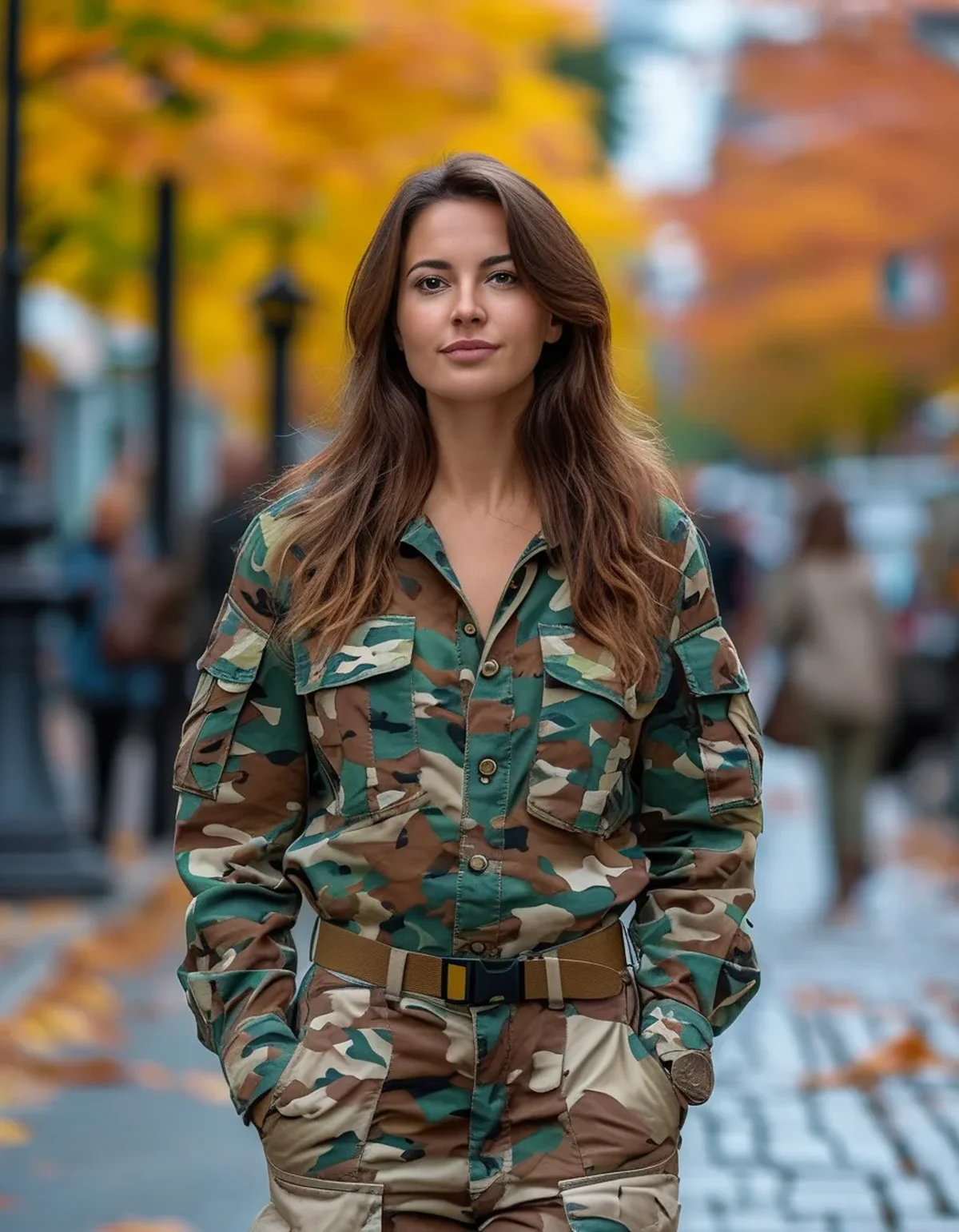
Piece one: an outer layer. A camo overshirt, utility jacket, or chore coat. This is the highest-value piece by a distance, because outerwear is worn over everything else and does the styling work without you having to build around it. Medium-scale print, structured rather than drapey.
Piece two: a bottom. Camo leggings, joggers, or straight-leg trousers depending on how you actually dress. Smaller-scale print here, because bottoms cover a large area and a big print across the leg is where costume territory begins.
Piece three: an accent. Trainers, a cap, a scarf, or a crossbody bag. Small surface area, so scale barely matters, and it’s the piece that lets you wear camo on a day when a jacket or trousers would be too much.
All three from the same base tone. Decide whether your wardrobe is olive-and-black or brown-and-camel, and buy camo in the family that matches. This one decision does more for wearability than anything else.
And avoid buying two pieces in the same category. Two camo jackets is a duplicate, not a capsule. If you already own two, keep the one that suits your existing neutrals and pass the other on.
The autumn detail: think about texture as well as print. A brushed cotton or a canvas camo reads seasonal in the coming weeks; a lightweight summer poplin version of the same print doesn’t, even in the same colour.
Myth vs Fact: Wearing Camo
Myth: Camo is a summer print. Fact: camo’s base tones - olive, khaki, brown, black - are inherently autumnal, and camo arguably works better against autumn textures like suede, wool, and denim than it does against summer linen.
Myth: Camo automatically looks tactical. Fact: the tactical read comes from the combination, not the print. Camo plus combat boots plus a utility belt reads military; camo plus a soft knit and a loafer reads styled. The print is neutral; the styling decides.
Myth: You can never mix camo with another pattern. Fact: it mixes well with stripes and with florals, provided one pattern is clearly dominant and the scales differ. It’s an intermediate move, not a forbidden one.
Myth: Camo suits everyone the same way. Fact: the base tone matters. Olive-based camo generally sits better with cool neutrals like black, grey, and navy; brown-based camo sits better with camel, cream, and warm browns. Picking the wrong family for your existing wardrobe is why a piece feels off.
Myth: More camo means more of the look. Fact: one camo piece plus solid neutrals is the formula that reliably works. Adding a second camo piece is a specific styling decision that requires matched base tones and different scales - not a default.
How do you build the outfits?
Formula one: camo outer plus all-neutral base. Black or cream underneath, camo jacket over. This is the everyday outfit and it works with almost anything already in your wardrobe.
Formula two: camo bottom plus solid top plus solid outer. The camo is the visual anchor at the bottom and everything above it stays quiet. Works particularly well with a cream or black knit as the evenings cool.
Formula three: full neutral outfit plus camo accent. The lowest-effort version and the one you’ll use most on days when you want something interesting without thinking about it.
Formula four: camo outer plus camo accent, matched tones. Two pieces, but with a large gap in surface area between them, so they read as coordinated rather than competing. This is the intermediate move.
Repeat one solid colour across the outfit. Picking up a colour that exists in the camo print - the olive, the black, the sand - in your top or shoes makes the whole thing look deliberate rather than assembled.
And add one autumn texture per outfit. Suede, corduroy, chunky knit, or leather against camo cotton reads as seasonal and stops the outfit feeling like a summer look with a jacket added.
FAQ: Building a Camo Capsule, Answered
How many camo pieces should I own?
Three is the practical sweet spot for most people: one outer layer, one bottom, one small accent. Beyond that you’re adding combinations you won’t wear rather than outfits you will.
Can I wear two camo pieces at once?
Yes, if they share a base tone and differ significantly in scale and surface area - a camo jacket with camo trainers works, a camo jacket with camo trousers usually doesn’t.
Which camo base tone should I buy?
Match it to the neutrals you already own. Olive-based camo sits comfortably with black, grey, and navy; brown-based camo sits comfortably with camel, cream, and warm brown. Owning both families makes both harder to wear.
How do I stop camo looking like a uniform?
Break the military associations with the pieces around it - a soft knit, a loafer or a low boot rather than a combat boot, and one genuinely feminine or unexpected texture. The print is neutral; the styling decides how it reads.
TL;DR:
- Three pieces - one outer, one bottom, one accent - produce more wearable outfits than five bought individually.
- Pick a single base tone family, olive-based or brown-based, and match it to the neutrals you already own.
- Vary scale across the three pieces so any two can coexist if you choose to combine them.
- The reliable formula is one camo piece plus solid neutrals; two camo pieces is a deliberate intermediate move.
- Add one autumn texture per outfit - suede, corduroy, chunky knit - so camo reads seasonal rather than leftover.
If you own five camo pieces and wear one, the problem isn’t styling. Keep the three that share a base tone and let the others go.
See It in Motion
Seen here: Super High Waist Embossed Yoga Leggings with Inner Pocket — shop it on bubblelime.com
Keep Reading
This article is for general informational and styling purposes only. Fit, sizing, and product availability may vary — check current details before purchasing.