Buying Camo Secondhand: What to Check Before You Commit

Quick Answer: The three things that decide whether a secondhand camo piece works are the base colour, the print scale, and whether it carries obvious military insignia. Look for a base that matches your existing neutrals, a print scale in proportion to your frame, and no visible patches, rank markings, or name tapes. Check the fabric weight too - genuine surplus is heavier than most people expect and wears very differently from a fashion reproduction.
Camo is one of the few prints where the secondhand version is often better made than the new one - and also the one where the wrong piece reads as fancy dress fastest.
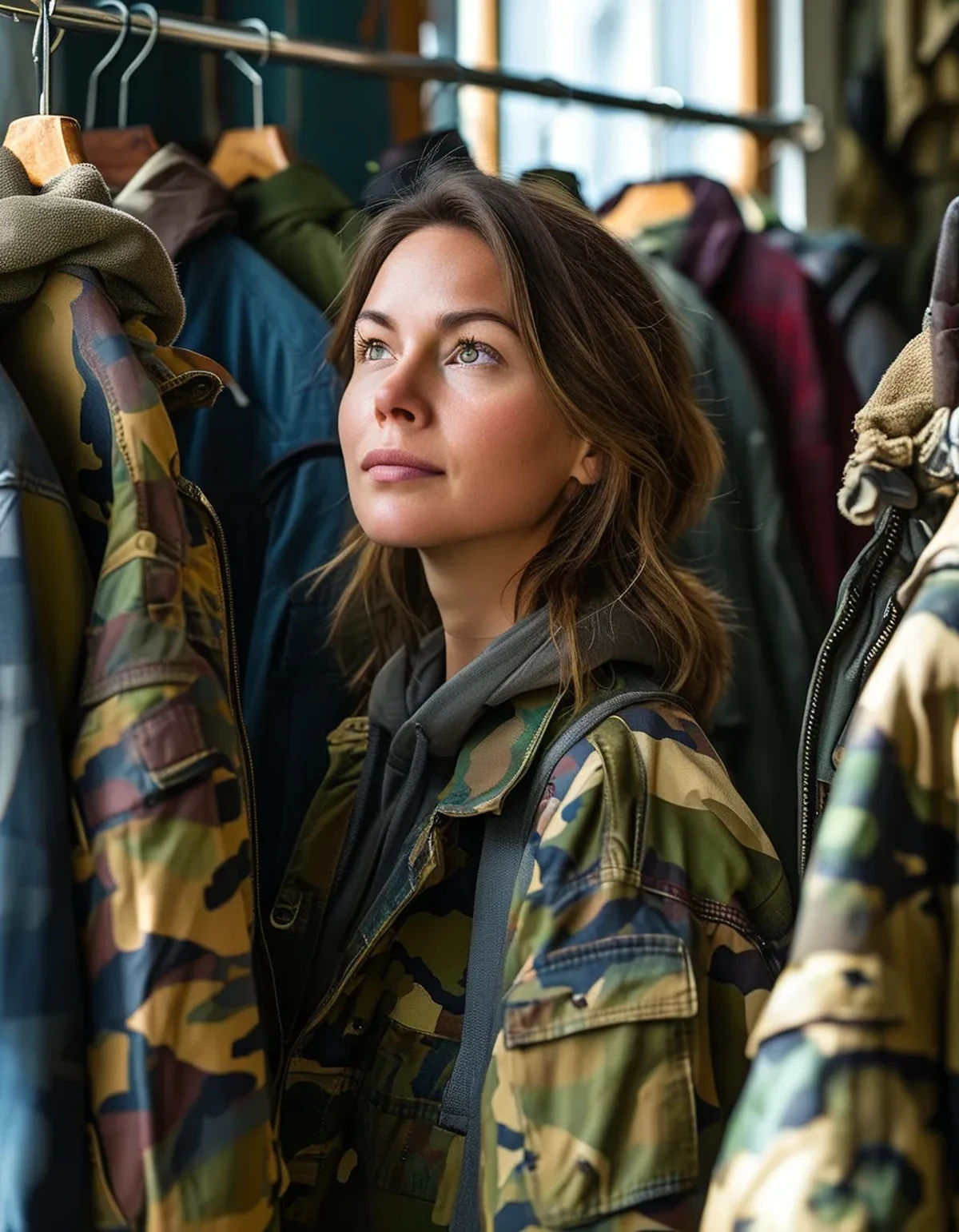
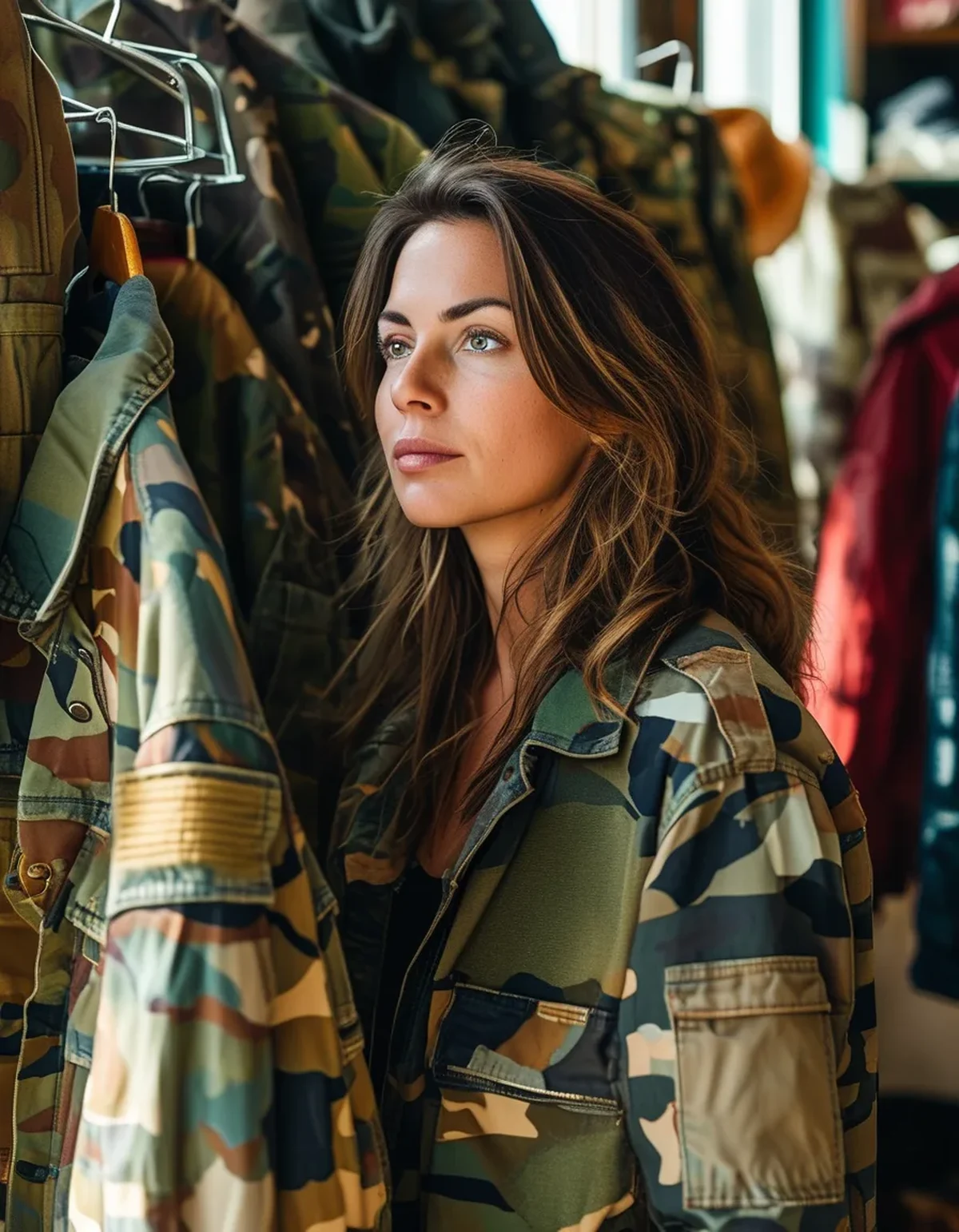
Why is secondhand the best place to buy camo?
Because the construction is usually better and the print has already softened.
Genuine surplus is built to a specification. Military garments are made to survive conditions no fashion jacket is designed for - reinforced stress points, heavy thread, functional pockets, and fabric weights well above high street equivalents. A surplus field jacket that has already survived a decade will comfortably survive another.
The fade is the point. New camo prints are high contrast, and high contrast is what makes camo read as costume. A washed, faded, softened print sits much closer to a neutral. You cannot buy that finish new at any price - a distressed reproduction always looks like a reproduction, because the fade is applied uniformly rather than earned in the places that actually wear.
The price gap is significant. Fashion camo carries a design markup for a print that costs nothing to apply. Surplus is priced as workwear.
What secondhand also gives you: unusual patterns. Different countries and eras used very different palettes - some far more wearable than the standard green-brown that everyone pictures. Scandinavian, French, and desert patterns in particular come in colourways that behave much more like neutrals in a modern wardrobe.
The tradeoffs, honestly: sizing is unfamiliar and usually oversized, condition varies enormously, and the fit is cut for a different body and a different purpose. Which is exactly why the checks below matter.
What should you check on the rail?
Six things, in about ninety seconds.
1. The base colour against your own neutrals. This is the single most important check. Camo comes in olive-based, brown-based, grey-based, and sand-based versions, and they behave completely differently in an outfit. Hold it next to something you actually own - if your wardrobe is black and grey, a brown-based camo will fight everything. If it is camel, cream and chocolate, an olive-and-brown camo slots straight in.
2. The print scale against your frame. Large blotches on a small frame overwhelm; tiny dense patterns on a larger frame read as busy texture rather than print. Hold the garment up at arm’s length and step back. The pattern should be readable as camo without dominating your outline.
3. Insignia. Name tapes, rank slides, unit patches, and flag patches are the fastest route to looking like fancy dress. Most can be unpicked, and the stitch holes sometimes remain. Check what is removable before you commit.
4. Fabric weight. Pick it up. Genuine surplus is heavy - a proper field jacket can weigh more than a wool coat. That is excellent for autumn and impractical as a summer layer. Fashion camo is usually a light cotton twill, which drapes differently and layers more easily.
5. Condition at the stress points. Elbows, cuffs, collar edge, pocket corners, and the seat if trousers. Fading is fine and often desirable. Thinning fabric and split seams at stress points are not worth repairing on a cheap piece.
6. Smell. Long-stored surplus can hold mustiness, mildew, or storage chemicals that survive several washes. Sniff the underarm and the inside of the collar. A musty smell is usually fixable; a chemical one often is not.
Which camo patterns are the easiest to wear?
The low-contrast ones, in an order that surprises most people.
Easiest:
- Faded olive-based patterns, where sun and washing have pulled everything toward a single mid-tone. These function as a neutral and will pair with almost anything in your wardrobe
- Grey and urban patterns, which sit naturally with black, charcoal, and denim - the easiest option for a cool-toned wardrobe
- Sand and desert patterns, excellent with cream, camel, and chocolate, and a genuinely good autumn option that most people overlook
- Small-scale dense patterns at a distance, which read as texture rather than print and are correspondingly easy
Harder:
- High-contrast new prints with sharp black against bright green. The contrast is what triggers the costume reading
- Very large-scale blotch patterns on anything other than an oversized outer layer
- Digital and pixelated patterns, which read as distinctly contemporary military rather than as fashion, and are harder to soften
- Bright or novelty camo in pink, purple or neon, which is a different item entirely and does not carry the neutral quality that makes camo useful
The base colour test, if you want one rule: identify the darkest colour in the print and ask whether you own trousers in that colour. If you do, the piece will integrate. If the darkest tone is something you never wear, it will sit unworn.
On mixing camo with other prints, briefly, because secondhand shopping tempts you: faded camo behaves as a neutral and will take a stripe or a leopard alongside it. High-contrast camo does not - it is the loudest thing in the outfit and needs everything else quiet.
Myth vs Fact: Secondhand Camo
Myth: Real surplus always looks better than fashion camo. Fact: It is usually better constructed, and it is also cut for a completely different body and purpose. A surplus jacket with correct shoulders and a good fade beats fashion camo easily. One that swamps you does not.
Myth: You should size up for the oversized look. Fact: Surplus is already cut large. Taking your usual size in surplus often produces the oversized proportion you wanted, and sizing up on top of that produces something shapeless. Check the shoulder seam position rather than the label.
Myth: Camo is a passing trend. Fact: It has cycled through fashion repeatedly since the 1960s and shows no sign of leaving permanently. A faded olive jacket has more in common with a trench than with a seasonal print.
Myth: You should remove all military markings. Fact: Rank slides, name tapes, and unit patches are worth removing for both style and sensitivity reasons. Manufacturer stamps, size labels, and stencilled numbers inside the garment are part of the history and nobody sees them.
Myth: Secondhand camo is always cheap. Fact: Certain patterns and eras have collector value, and vintage designer camo can be expensive. If a piece is priced well above surplus rates, it is worth knowing what you are paying for before assuming it is overpriced.
Myth: You can wash surplus like anything else. Fact: Some older military fabrics carry water-repellent or flame-retardant treatments that react badly to hot water and modern detergents. Cold wash the first time and see what happens before committing.
How do you style a secondhand piece so it does not read as costume?
Three rules, and the first one does most of the work.
One camo piece, everything else plain. Camo trousers with a camo jacket is a uniform, and it will read as one. One piece, treated as the print in the outfit, with solid neutrals around it.
Pair it with something unmistakably not-military. This is the trick that separates a styled outfit from a surplus outfit. A camo jacket over a slip dress, with heeled boots, or with a fine knit and tailored trousers. The contrast in register is what signals intent. Camo with combat boots, cargo trousers, and a plain green tee reads as one coherent - and unintended - reference.
Let the fit do some work. A surplus jacket left open, sleeves pushed up, over a fitted base gives you shape. Buttoned to the neck over loose layers gives you a box.
Three combinations that consistently work in autumn:
- Faded camo jacket, cream knit, straight dark denim, ankle boots. The most versatile
- Camo jacket over black leggings and a longline black top, which is the athleisure version and works because everything under the jacket is one colour
- Camo trousers, plain black or cream fine knit, simple flat shoe. With trousers, the top half needs to be quieter than usual
On the fit alterations worth paying for: shortening sleeves on a surplus jacket is cheap and transforms the proportion. Taking in the body is more expensive and often unnecessary given that the volume is the point. Hemming surplus trousers is essentially always worth it - the length is the single most costume-triggering detail on a pair of military trousers.
A final consideration. Camouflage carries military associations that some people feel strongly about, and wearing genuine issued items with identifiable unit or name markings can read as claiming something. Removing the identifying insignia is the straightforward answer, and it is also the styling advice - the markings are what makes it read as a uniform rather than a jacket.
FAQ: Secondhand Camo Questions, Answered
What size should I buy in surplus?
Usually your normal size, because military cuts are already generous. Check where the shoulder seam falls rather than trusting the label, and expect sleeve length to run long.
Which camo base colour is most versatile?
A faded olive-brown for warm wardrobes, and a grey or urban pattern for wardrobes built on black and charcoal. Sand patterns are underrated with camel and cream.
Should I remove patches and name tapes?
Yes - identifying insignia is both the fastest costume trigger and the detail most worth removing for sensitivity reasons. Check for remaining stitch holes before buying.
How do I wash old surplus?
Cold, gentle, and on its own the first time. Some older fabrics carry treatments that react to hot water, and heavy cotton can bleed. Air dry rather than tumble.
TL;DR:
- Secondhand camo is usually better made than fashion camo, and the faded print reads far more like a neutral
- Check base colour against your own wardrobe first - it decides whether the piece gets worn
- Remove name tapes, rank slides and unit patches; they are the fastest route to looking like fancy dress
- Surplus runs large, so take your normal size and judge by the shoulder seam
- One camo piece with plain neutrals, and pair it with something deliberately not-military
The best camo find is the one that is faded enough to behave like olive, and the rail is full of them right now.
Keep Reading
This article is for general informational and styling purposes only. Fit, sizing, and product availability may vary — check current details before purchasing.